



In international trade, trust is often the biggest challenge. Buyers and sellers operate across borders, legal systems, and currencies—sometimes without ever meeting. This is where a Letter of Credit (LC) becomes essential.
A Letter of Credit is one of the most powerful tools in international trade finance. It transforms uncertain transactions into structured, secure agreements backed by banks.
A Letter of Credit is a financial instrument issued by a bank that guarantees payment to a seller, provided that specific conditions and documents are met.
In simple terms:
? It replaces trust between buyer and seller with the credibility of a bank.
What Is a Letter of Credit?
A Letter of Credit is essentially:
- A bank’s promise to pay
- Issed on behalf of a buyer (importer)
- In favor of a seller (exporter)
- Conditional on documents, not goods
This means the bank doesn’t check the physical goods—it checks whether the required documents (invoice, bill of lading, etc.) are correct.
Why Is a Letter of Credit Used?
? Core Problem in Trade:
- Exporter fears: “Will I get paid?”
- Importer fears: “Will I receive the goods?”
✅ LC Solution:
- Protects both parties simultaneously
- Reduces risk in first-time or international transactions
- Enables secure global trade
? This is why LCs are widely used when:
- Parties don’t know each other
- Transactions involve large amounts
- Countries have different legal systems
Key Parties in a Letter of Credit
Understanding LC requires knowing the main actors:
- Applicant (Buyer / Importer)
Requests the LC from their bank. - Beneficiary (Seller / Exporter)
Receives payment under the LC. - Issuing Bank
Guarantees payment on behalf of the buyer. - Advising Bank
Notifies the seller that the LC has been issued.
These roles form the backbone of every LC transaction.
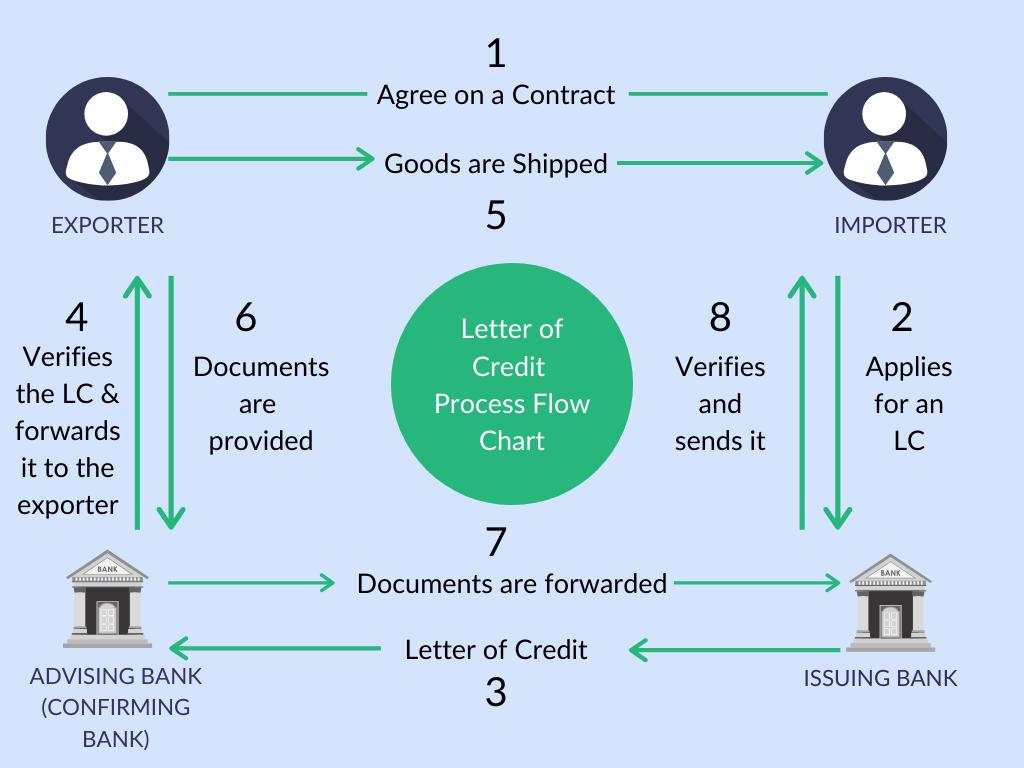
How a Letter of Credit Works (Step-by-Step)
Here’s the typical flow:
- Contract Agreement
Buyer and seller agree to use a Letter of Credit.
- LC Issuance
Buyer requests their bank to issue an LC.
- LC Notification
Seller receives the LC via an advising bank.
- Shipment of Goods
Seller ships goods as per agreement.
- Document Submission
Seller submits required documents to the bank.
- Document Verification
Bank checks documents for compliance.
- Payment
If documents match → seller gets paid.
The Critical Concept: “Documents Over Goods”
One of the most important principles:
? Banks deal only with documents, not the actual goods.
This means:
- Even if goods are defective, payment can still happen
- As long as documents strictly match the LC terms
This strict compliance requirement is why LCs demand precision and accuracy.
Advantages of a Letter of Credit
For Exporters (Sellers)
- Guaranteed payment (if conditions met)
- Reduced buyer default risk
- Access to financing
For Importers (Buyers)
- Payment only after shipment
- Ensures seller meets conditions
- Builds trust with new suppliers
Common Risks and Challenges
Despite its benefits, LC is not risk-free:
⚠️ Document Discrepancies
- Even small errors can lead to non-payment
- Up to ~70% of LCs face issues on first submission (industry insight)
⚠️ Cost
- Bank fees can be significant
⚠️ Complexity
- Requires expertise in documentation and compliance
Types of Letters of Credit (Simplified)
Some commonly used types include:
- Irrevocable LC – Cannot be changed without agreement
- Confirmed LC – Additional bank guarantee
- Sight LC – Immediate payment
- Usance LC – Payment after a delay
- Standby LC – Acts as a backup guarantee
Sources: